The Story
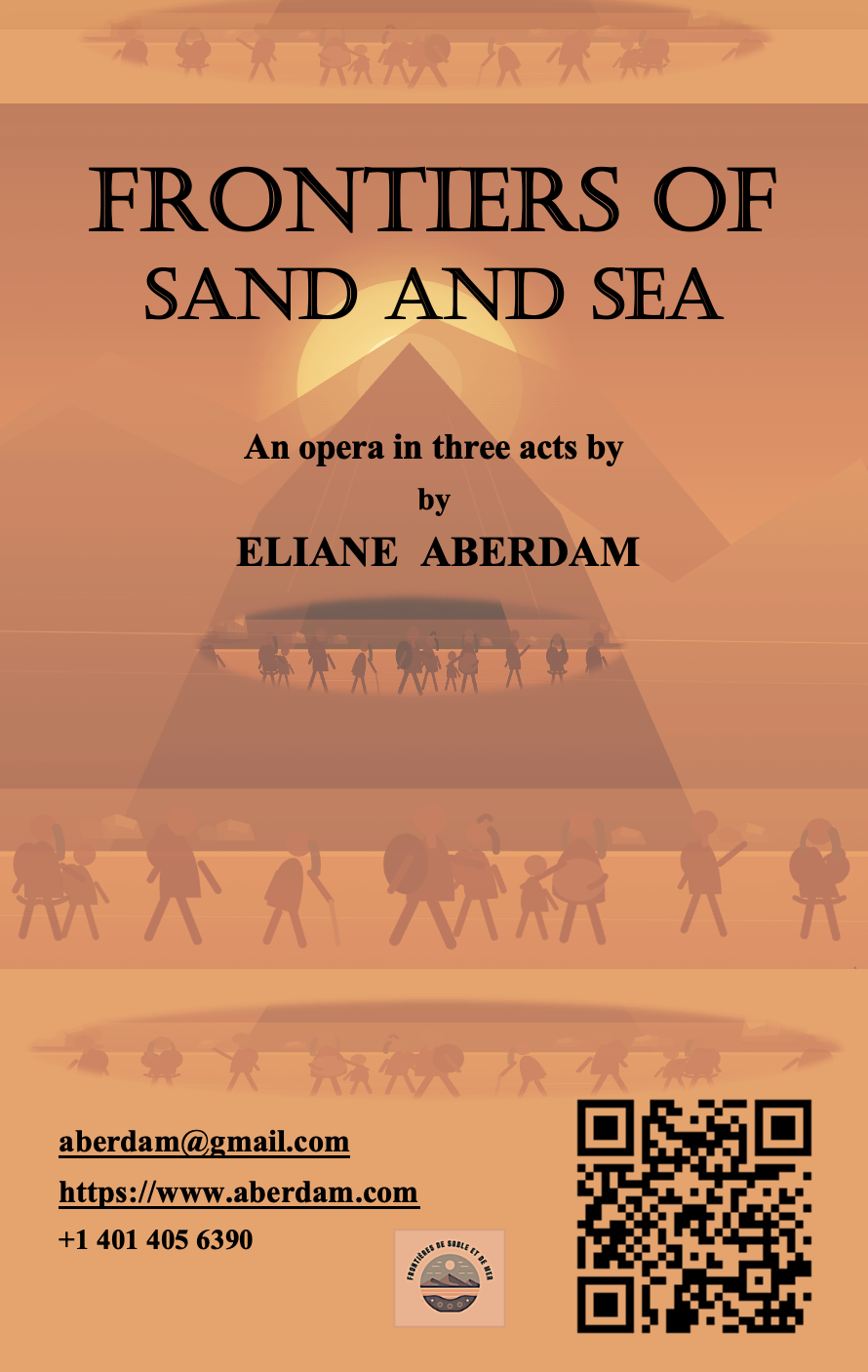
Frontiers of Sand and Sea, is a three-act opera in fourteen scenes written in French (my mother tongue). The opera addresses the refugee crisis without naming specific countries. This universal theme makes Frontiers of Sand and Sea stageable anywhere. Like my three previous operas, Frontiers is about social justice. I believe that as a composer, I must advocate for social issues close to my heart.
The story is told through Ramita, a young mother who is forced to leave her village because of war, famine, and violence. Ramita must leave her children and mother-in-law in a refugee camp across the border before continuing her journey in search of safety. What follows is a brutal, unrelenting ordeal through deserts, prisons, and tempest at sea, all marked by loss, abuse, and survival. Against all odds, hope endures, carried by those who have survived.
Frontiers is written for seven singers, a small SATB chorus, and a chamber group of nine (five strings, flute, clarinet, piano, percussion). A narrator uses UN data, statistics, and legal definitions to ground the work in reality
FRONTIERS OF SAND AND SEA
SYNOPSIS
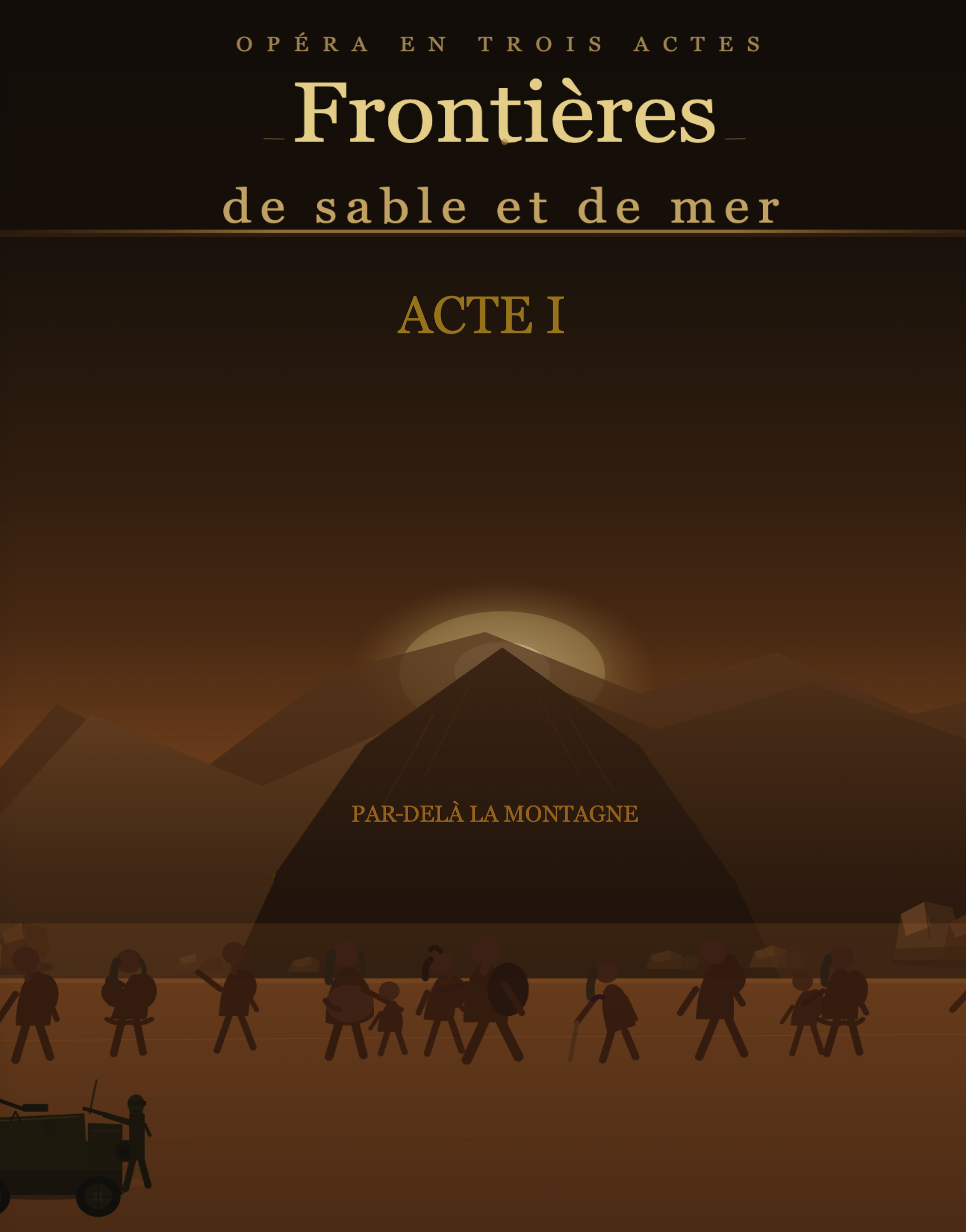
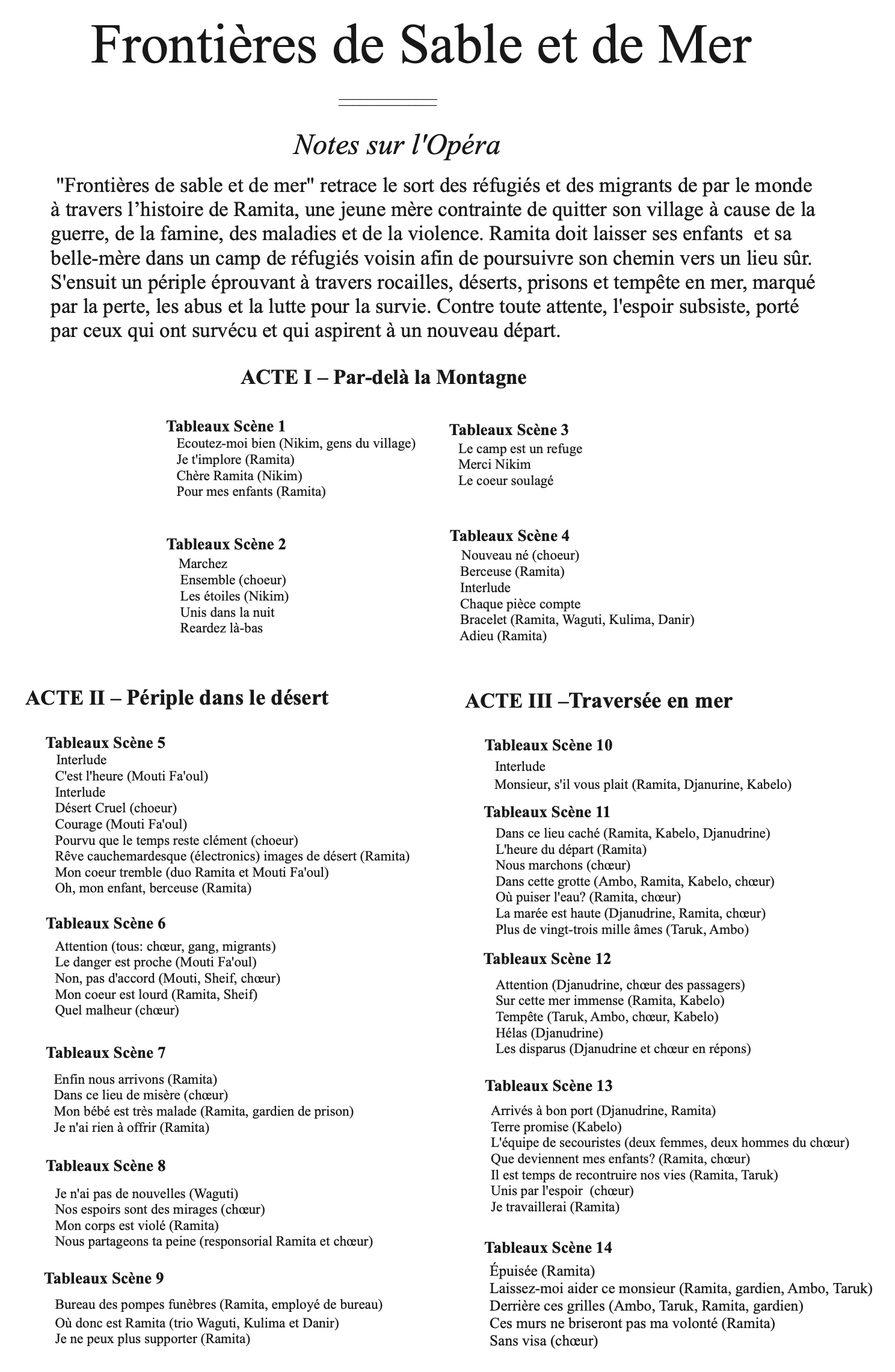
Act I is the crossing of the mountain. It opens with smuggler Nikim; he can help cross the border to a refugee camp. Ramita begs him to take her across the border with her mother-in-law and her two children. Nikim leads them across the mountain. A few weeks later, Ramita gives birth in the refugee camp. She will take her newborn to cross the desert, leaving behind the rest of her family. She takes a little money and her mother-in-law's bracelet, hiding it in a hairband the same color of her hair.
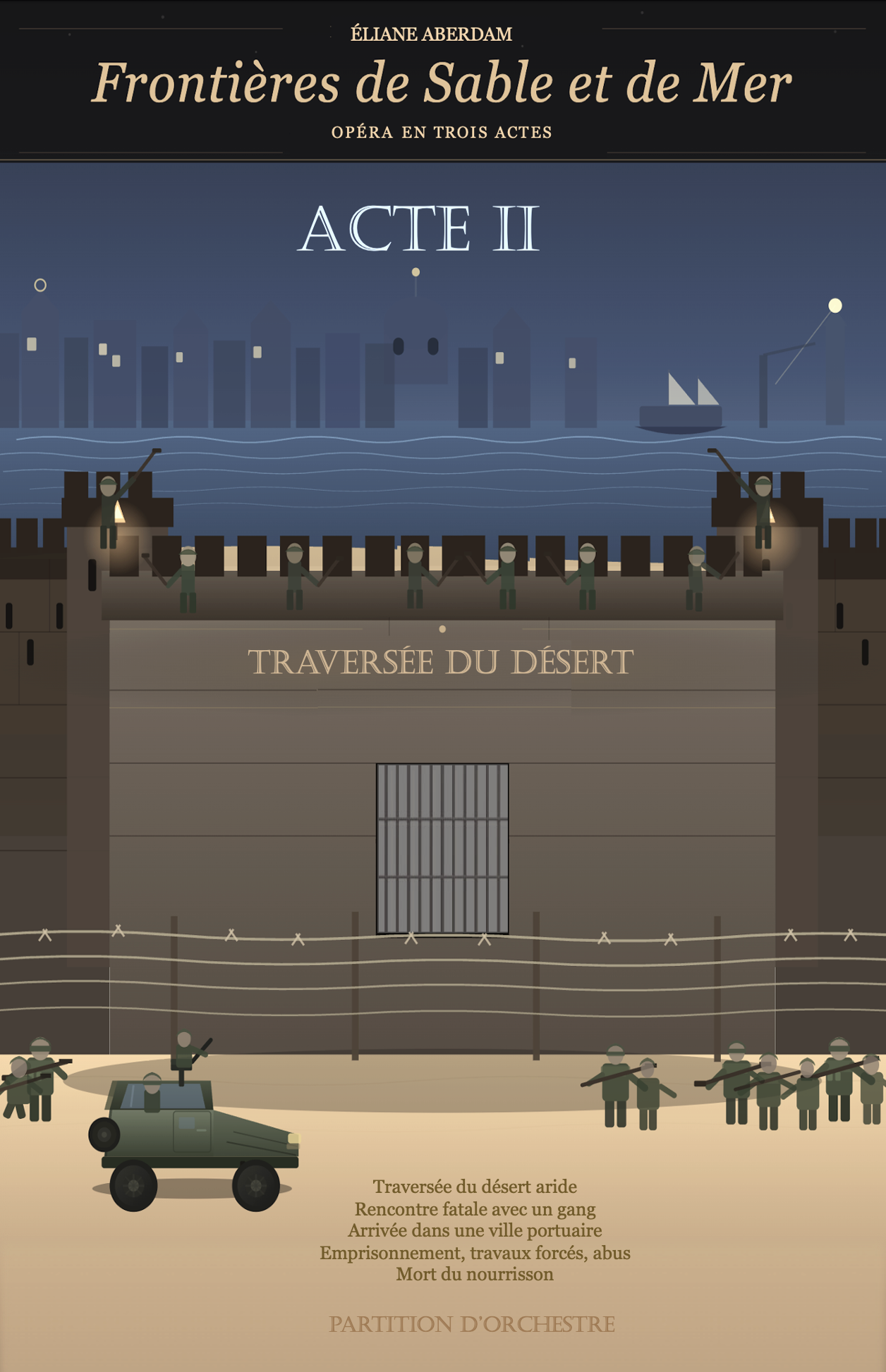
In Act II smuggler Mouti Fa'oul helps a group of refugees cross the scorching desert. Unfortunately, they encounter a militia. The gangster Sheif is now in charge. He confiscates their money, food and water. Ramita's infant gets sick. They arrive in a port town and are thrown in jail and relentlessly abused. The infant dies. Upon her release, Ramita goes to a funeral home but cannot find the body of her child.
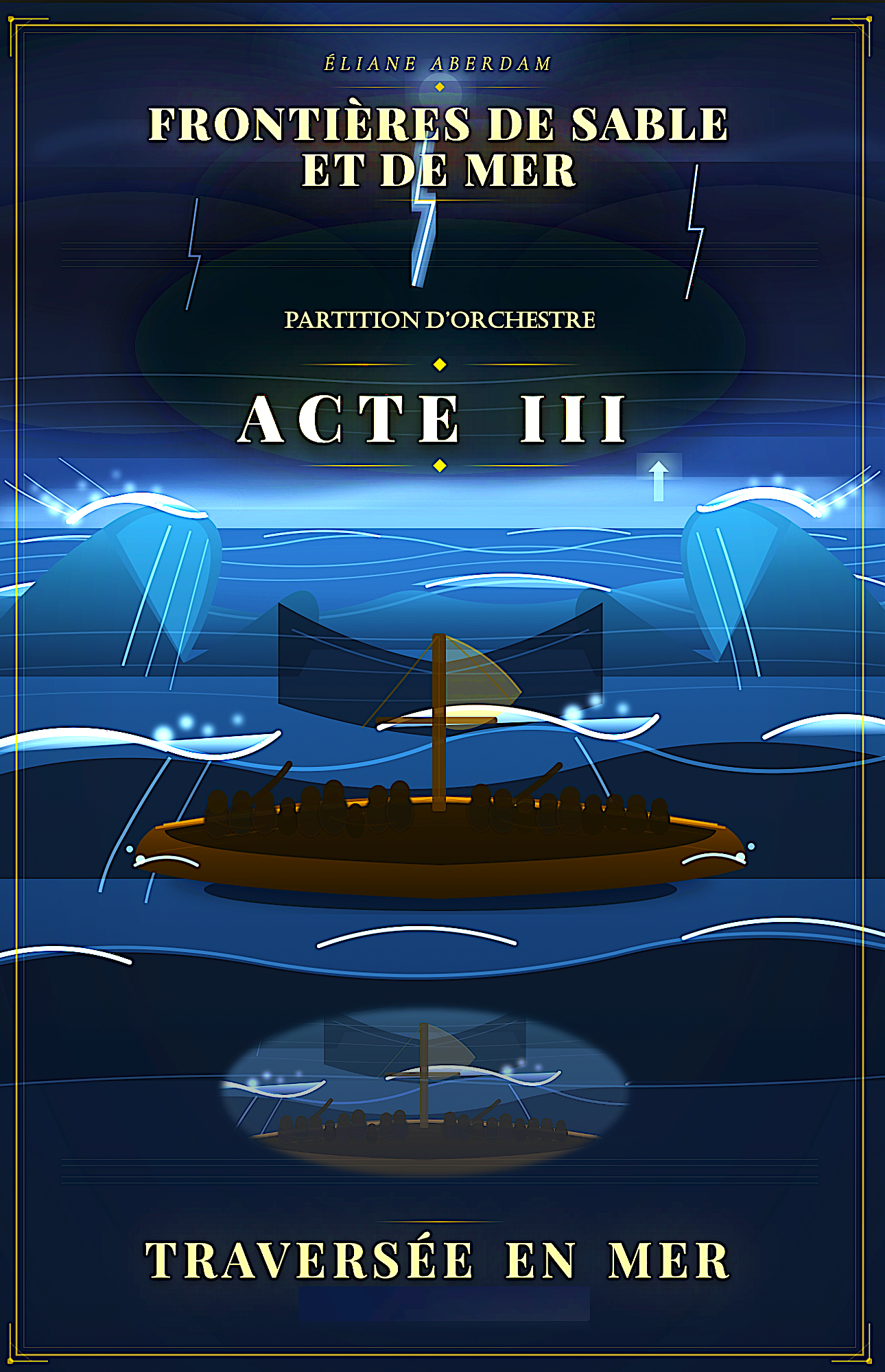
Act III is about crossing the sea. Ramita meets Captain Djanudrine. She pays her fare with her bracelet. The boat is moored in a secret location a few miles from town. The group must wait for the next moonless night before embarking. A vicious storm kills five men, but the captain manages to prevent the worst. They finally reach a safe port. Ramita wants to work as an interpreter in a refugee relief association. The act ends in a detention center,; refugees hope to obtain legal asylum papers.
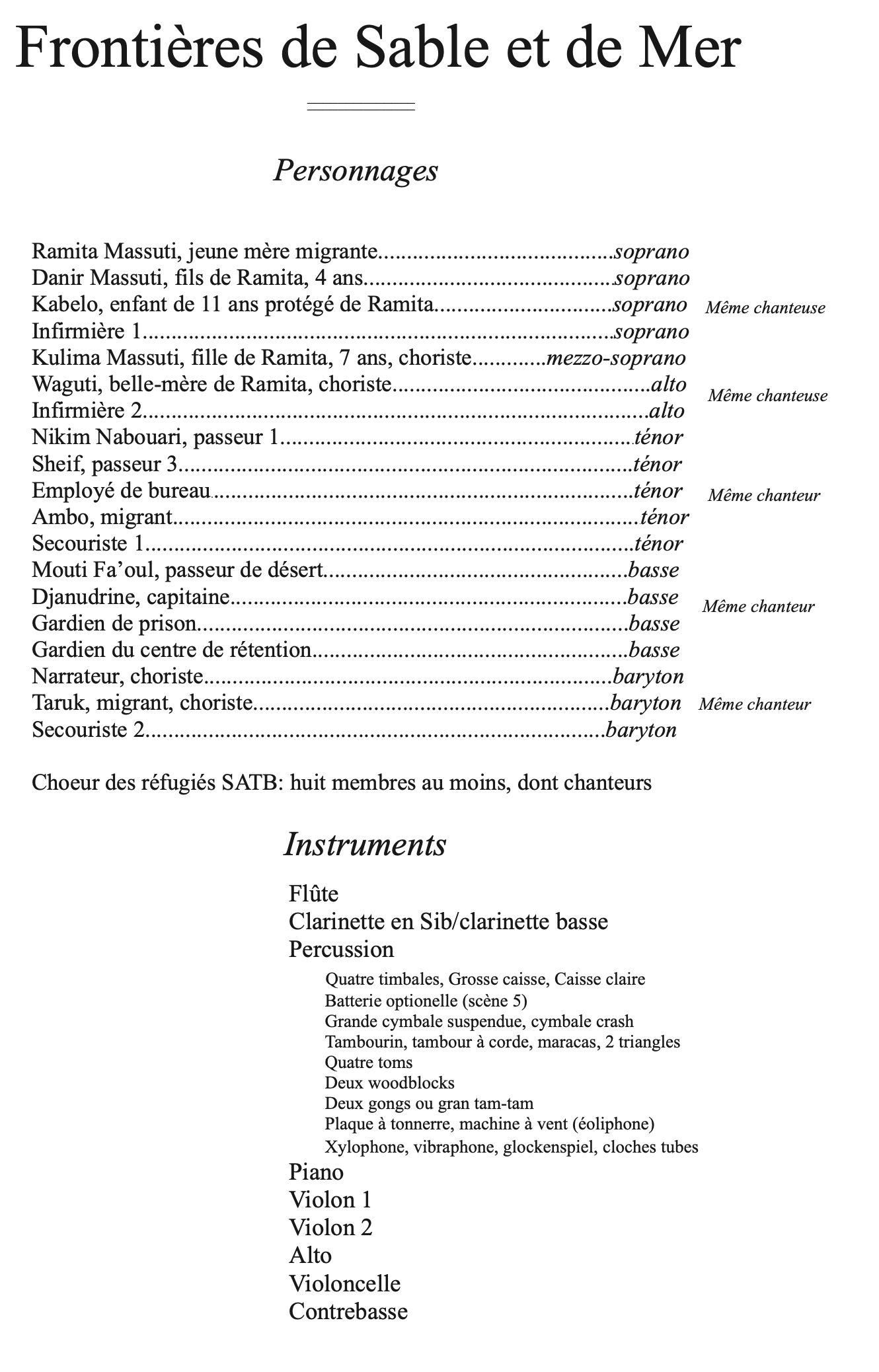
Forces for Frontiers (Chamber Opera)
Flute
Clarinet
Percussion
Piano
Violin 1
Violin 2
Viola
Cello
Double bass
Electronics (pre-recorded sound files for two tableaux)
Singers
LEAD SOPRANO: Ramita Massuti, Young mother, migrant/refugee
SOPRANO: Danir and Kabelo (11-year-old child protected by Ramita)
ALTO: Waguti (also member of the chorus)
MEZZO-SOPRANO: Kulima (also member of the chorus)
TENOR: Nikim Nabouari, Sheif, Office worker, Ambo (also member of the chorus)
BASS: Mouti Fa'oul, Djanudrine, Taruk
MALE VOICE: Guardian of fort and detention center, (also member of the chorus)
MALE VOICE: Narrator: tenor or bass (also member of the chorus)
SATB Chorus: Eight members (minimum)
Main Characters
Ramita Massuti, Lead role, young mother, Soprano
Waguti, mother-in-law, Alto
Kulima Massuti, 7 years old daughter, Mezzo-soprano
Danir Massuti, 4 years old son, Soprano
Kabelo, 11-year-old, migrant child, Soprano
Nikim Nabouari, mountain guide, Tenor
Mouti Fa’oul, desert smuggler, Bass
Sheif (militia/gang leader), Tenor
Captain Djanudrine, Bass
Funeral home employee, Tenor
Ambo, passenger on the boat, Tenor
Taruk, passenger on the boat, Bass
Guardian (fort and detention center) Tenor or Bass
Narrator of Data and Statistics: Tenor or Bass
Mixed Choir (SATB), at least 8 members
Chorus of migrants/refugees
Rescue Team: four chorus members (SATB)
TEASER
Watch the teaser of E. Aberdam's opera Frontiers of Sand and Sea about the plight of refugees. Ramita, a young mother flees her village because of war and famine in hope to find a safer place. Her journey is harrowing, but hope helps her overcome the worst.
Frontiers of Sand and Sea
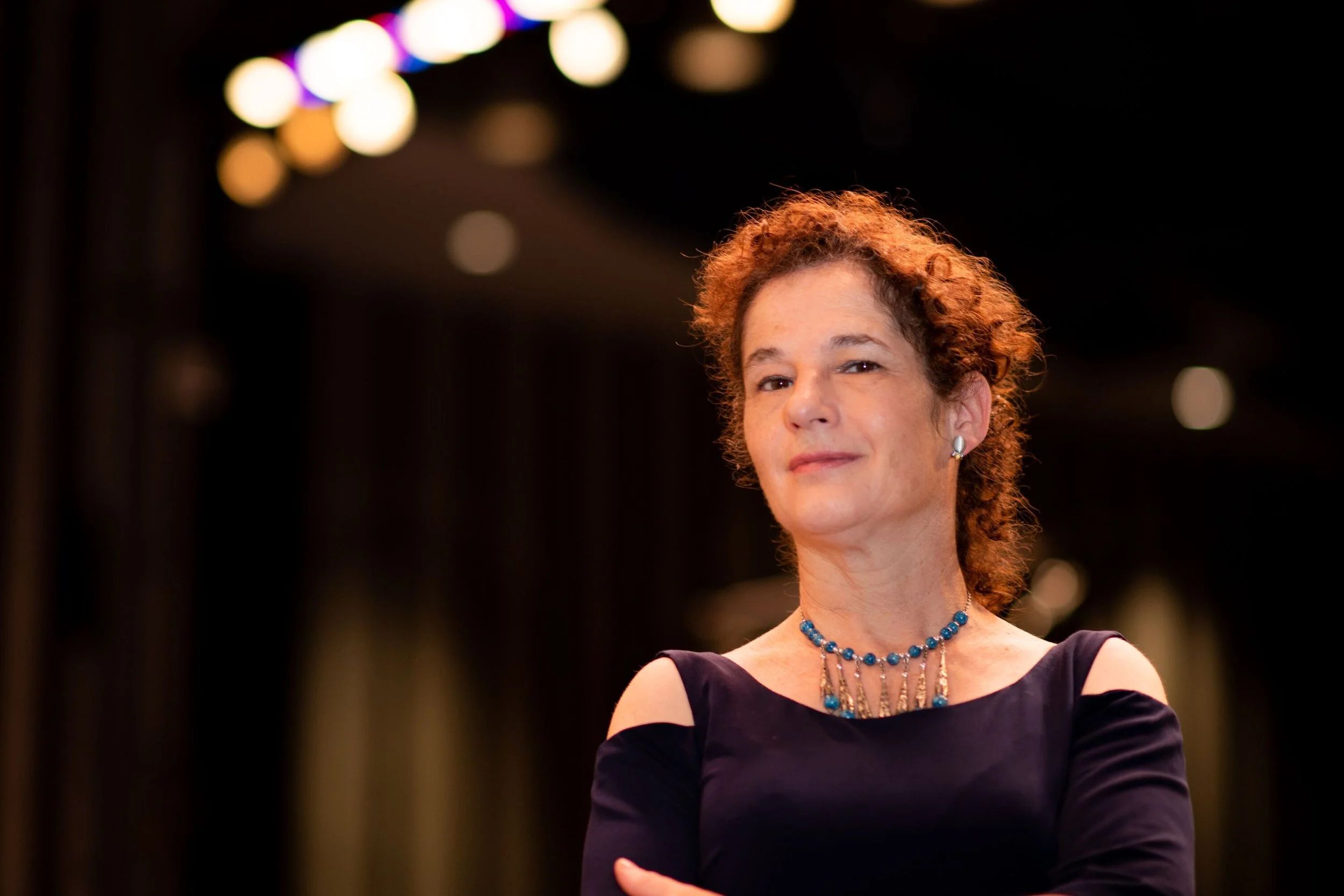
Eliane Aberdam completed her BM in composition in 1988 at the Rubin Academy of Music and Dance in Jerusalem where she studied with Mark Kopytman. In 1989, she entered the graduate program at the University of Pennsylvania where she studied with George Crumb and obtained her M.M. in Composition in 1992. She completed her Ph.D. in Composition at U.C. Berkeley in 1998. In 1998-1999, she taught composition, theory and Music technology at the University of Northern Iowa. Her works have been performed in Europe, Israel, and the United States. She attended music festivals such as The Bartok Seminar in Hungary, June in Buffalo, the Académie d' Été in Paris, and Voix Nouvelles in Royaumont (France). In 1995, she was selected by IRCAM for the Annual Course in electronic music, and for the commission of "PaRDeS", an electro-acoustic work for chamber ensemble and electronics. In 1998, Kent Nagano selected her four-movement orchestral piece Astéroïde 622 for a concert with the Berkeley Symphony Orchestra.
In 2000, the Ensemble InterContemporain (Paris), under the direction of David Robertson, commissioned and premiered the chamber orchestra piece "Quoi? Ce point." In 2007, Ketty Nez commissioned Tête à Tête for the Wolfe/Nez Duo. Her Grisailles Vaporeuses piano trio was performed by Trio Casals at Carnegie Hall in February 2020, and by the Kingston Chamber Music Festival (2018) among others.
Aberdam has composed three operatic works: Tamar and Shahrazad, are about domestic violence, and In Our Own Words is about inter-racial adoption. Aberdam is inspired by topics such as climate change, social, political, and racial injustices. She recently completed a chorus piece Doors about the plight of refugees (based on texts written by refugees/asylum seekers). Her concerto Otohime for double bass and orchestra won second place in the Donne in Musica composition contest in 2017, and was premiered in Chisinau, Moldova (2019). Her violin concerto In Memoriam for the fallen fighters in Ukraine was premiered in Kyiv in June 2023. Her guitar solo piece, Purushartha, was released on Modern Classical X in February 2025.
Aberdam has just completed her fourth opera Frontiers of Sand and Sea about the predicament of migrants and refugees. She has been teaching composition and theory at the University of Rhode Island since 2001.
Biography
LINKS TO LIBRETTO AND SCORE
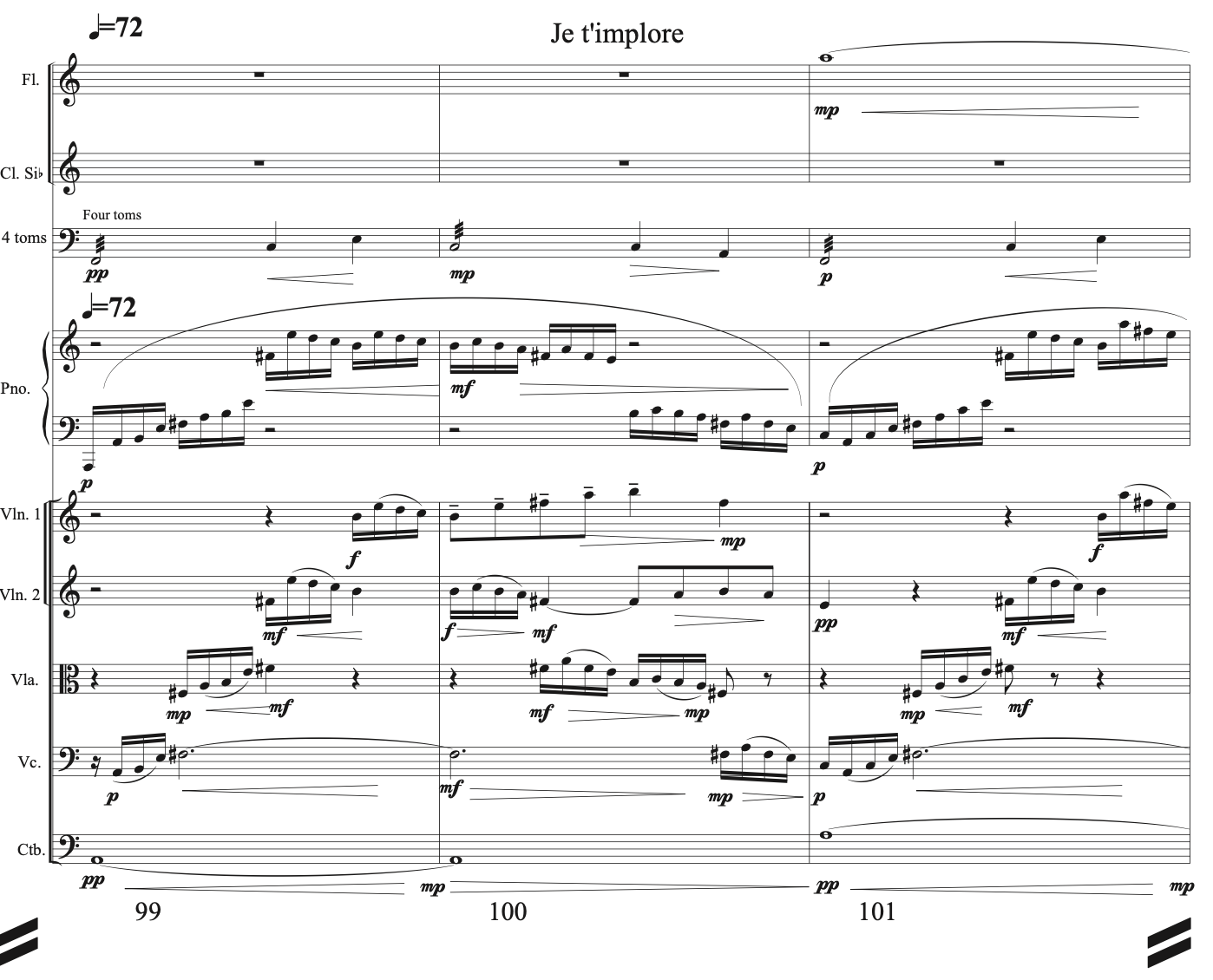
For the full score, please contact me
Big Musical Ideas for a
Real Social Impact.
Video of Selected Scenes
"Frontières de sable et de mer" is an opera (in French) by Eliane Aberdam about the fate of refugees and migrants worldwide, through the story Ramita, a young mother who is forced to leave her village because of war, famine, diseases, and violence.
Selected Video-Recorded Scenes
COURAGE
Mouti Fa’oul encourages migrants during the crossing of the fierce, sweltering desert, and warns them of the dangers. They must remain invisible and silent.
TEMPEST
The sea threatens to engulf the boat. The chorus is panicking, and Kabelo is frightened. The orchestra imitates the swelling of the waves.
RAMITA’S NIGHTMARE
Ramita’s nightmare at the Fort is a pre-recorded scene mixed with electronics. She is worried about her children’s well-being.
MY BODY
Ramita recounts the horror of her repeated rapes during her imprisonment at the Fort. Her soul is tortured but her heart still beats in hope of freedom.
ADIEU
The chorus sings Adieu to the refugee camp before undertaking the crossing of the desert. They take a little money and a few belongings.
FUNERAL HOME
After the death of her infant and her release from the fort, Ramita goes to the Funeral Home in the port town in hope to find the body of her baby there. To no avail.